
Sales Intelligence Software for B2B Teams


TL;DR
Compare sales intelligence software for B2B teams, including AI meeting support, contact data, intent signals, CRM automation, pricing, and fit.
Sales teams can have plenty of data and still walk into a call unprepared. The gap is often between finding a signal and using it in the conversation. Here are 10 sales intelligence software options, with a clear view of who each tool fits, what it does well, and where it stops.
1. VibeSell, real-time support before, during, and after sales meetings
VibeSell is a real-time AI sales companion for B2B teams. It prepares the rep before the meeting, gives sparse prompts during the call, then drafts the follow-up and CRM updates before the call ends.

It fits CROs, sales leaders, and enablement teams that want less admin without taking control away from reps. A pre-call brief pulls together company context, attendee details, prior meeting notes, talking points, and discovery questions. Recurring meetings can start with the last conversation in view instead of a blank screen.
During the call, VibeSell can surface objection handling, competitor information, next actions, and sales-stage prompts. Guidance can follow a team method such as MEDDIC or BANT. The prompts are deliberately sparse, since a rep who watches an assistant more than the buyer has a different problem.
After the meeting, VibeSell drafts the summary, follow-up email, and CRM changes for HubSpot or Salesforce. The rep approves the changes before anything reaches the CRM. That suggestion-first flow matters when leaders need cleaner records but don't want an AI system writing unchecked notes.
VibeSell also includes Ask Vibe, practice calls, call replays, account records, battle cards, and playbooks. Transcription supports 99 languages, with EU data residency available. It works through a Chrome extension with Google Meet, Microsoft Teams, and Cisco Webex.
Key Takeaway: Choose VibeSell when the main gap is meeting execution, not access to another contact database.
2. ZoomInfo, broad B2B data with deep CRM connectivity
ZoomInfo is built for teams that need a large B2B data source connected to their revenue systems. Its main use is finding companies and contacts, then making that data available inside CRM and sales workflows.
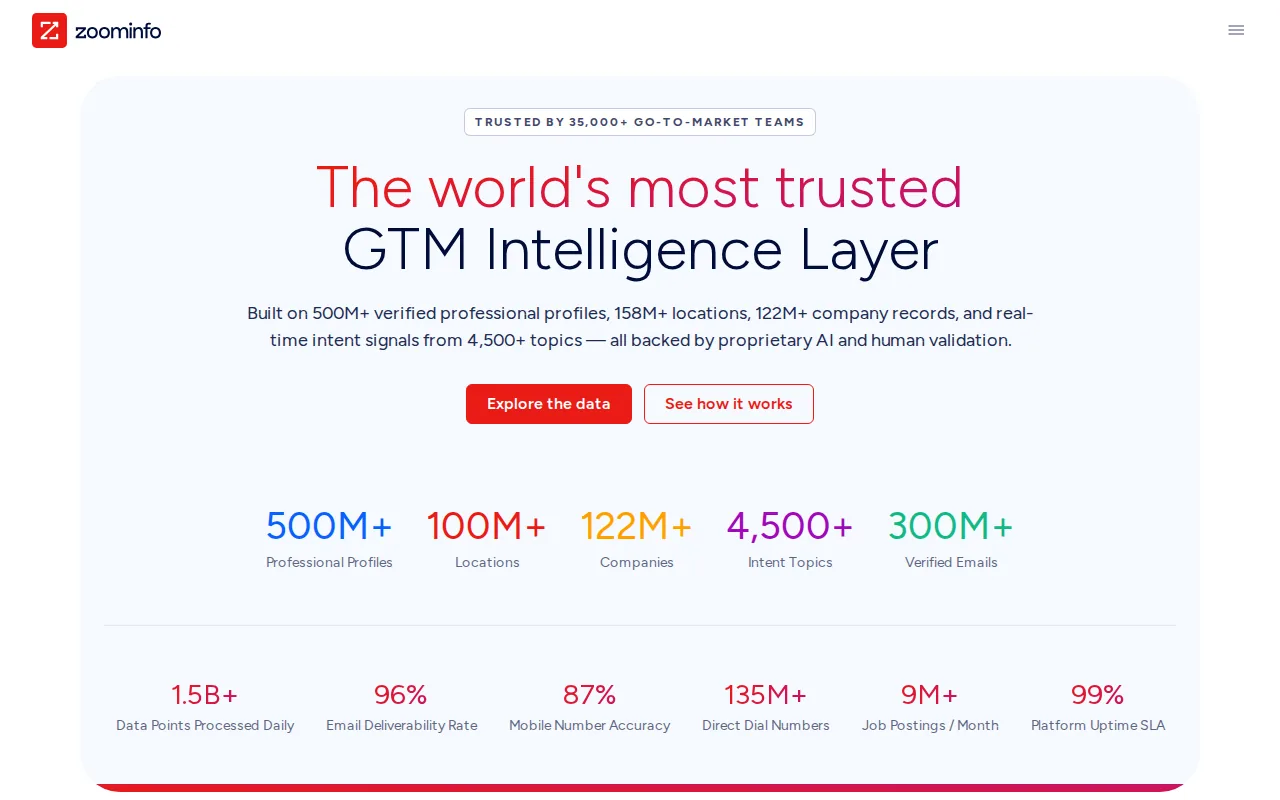
It suits enterprise RevOps teams with complex data needs and a budget for setup. ZoomInfo has the biggest B2B database on the market and the deepest CRM integration ecosystem.
That breadth can help when account planning starts with a narrow market. A team can define firmographic filters, find likely buyers, then push records into its existing process. CRM connectivity also reduces the need for reps to copy details by hand between tabs.
The trade-off is cost and scope. ZoomInfo helps answer who to target and what account data is available. It doesn't replace the meeting layer that prepares a rep, coaches a live conversation, and drafts approved follow-up. Teams may still need separate tools for engagement, call support, and deliverability.
Data breadth also creates a review task. RevOps should test coverage in its own market, check data freshness, define duplicate rules, and set clear CRM ownership before a broad rollout. A large record count won't fix weak account definitions.
For a team that already has strong meeting and outreach processes, ZoomInfo can fill the data gap. For a smaller team still building its workflow, the wider stack may feel heavy.
3. Cognism, phone-verified contact data for international prospecting
Cognism is aimed at teams that rely on phone outreach, with a particular fit for international and EMEA prospecting. Its key distinction is phone-verified mobile data and a workflow built around finding reachable contacts.
The tool suits sales development teams that have a defined territory and want to improve the chance that a phone number connects to the right person. Cognism has a Chrome extension plus native CRM integrations.
That setup can support a rep who finds an account during research and needs contact details without leaving the workflow. It also gives RevOps a clearer path for moving records into the CRM, where ownership and activity can be tracked.
Phone quality is the main reason to consider Cognism. If calls are the team's primary channel, verified mobile data may matter more than a wider set of low-use fields. It can also support market entry work when the team sells across several countries.
There is a clear limit. Cognism is data-first. It doesn't provide VibeSell-style live guidance during the conversation, and it isn't the same as an AI meeting companion that prepares a brief or writes approved CRM updates after the call.
Teams should also test coverage by country, role, and company size before signing a large contract. A data provider can look strong in a demo and still have uneven depth in a specific niche. Use a small test list and measure connection quality before expanding.
Cognism makes the most sense when reaching the person by phone is the main bottleneck.
4. Apollo, accessible data and engagement with a free tier
Apollo combines contact data with sales engagement in one system. It is aimed at founders, small teams, and SDR groups that want to test prospecting without buying several separate tools at once.
Apollo offers an accessible combination of data and engagement with a free tier. Its free entry point is useful for testing database coverage in a specific market before committing budget.
A team can build a target list, set filters, and begin an outreach workflow in the same product. That can reduce early stack complexity for a founder-led sales motion.
Intent data can help reps focus on a smaller set of accounts instead of treating every cold prospect as equal.
The caveat is that low entry cost doesn't mean predictable cost at scale. Credit use, verification, exports, and extra activity can change the total. Teams should track cost per usable contact and bounce rate, not only the subscription line.
Apollo also focuses on prospecting and engagement. It won't solve a sales leader's need for live call guidance, meeting continuity, or approved post-call CRM updates. If those are the pain points, adding Apollo may leave the core problem untouched.
Use the free tier to test the market you actually sell into. Don't judge coverage from a broad demo list.
Pro Tip: Before buying any data tool, test 50 to 100 target accounts and record how many contacts are usable, current, and relevant to your buyer role.
5. 6sense, anonymous buyer intent and account prioritization
6sense helps sales and marketing teams prioritize accounts that may be researching a purchase before they fill out a form. It is a strong fit for account-based programs with enough traffic, campaign data, and process maturity to act on intent signals.
6sense finds buyers who haven't raised their hands yet. Its predictive approach can help teams score accounts, focus campaigns, and decide when an outbound touch is worth the effort.
There are several useful motions here. Inbound teams can sort known visitors by likely fit. Outbound teams can look for accounts researching related topics without visiting their site. Sales and marketing can also build competitive takeout plays around accounts evaluating another provider.
Advertising is part of that account-based approach. A company might show ads to accounts at a later buying stage, then give sales a reason to follow up. The value depends on clean account lists and a clear handoff between marketing and sales.
Setup is the main concern for smaller teams. Predictive models need usable data and enough process discipline to avoid turning every signal into a task. Intent doesn't prove that a buying group has budget, authority, or a current project.
6sense also sits mainly before the meeting. It can help decide which accounts deserve attention, but the rep still needs preparation and support once the buyer joins the call. Pairing intent with a meeting workflow is more useful than sending a signal into an unattended queue.
Choose 6sense when account prioritization is a shared revenue process, not a single rep's side project.
6. Demandbase, account-based intelligence with advertising connections
Demandbase connects account intelligence with account-based advertising. It fits teams that want marketing activity and sales focus to work from the same target account view.
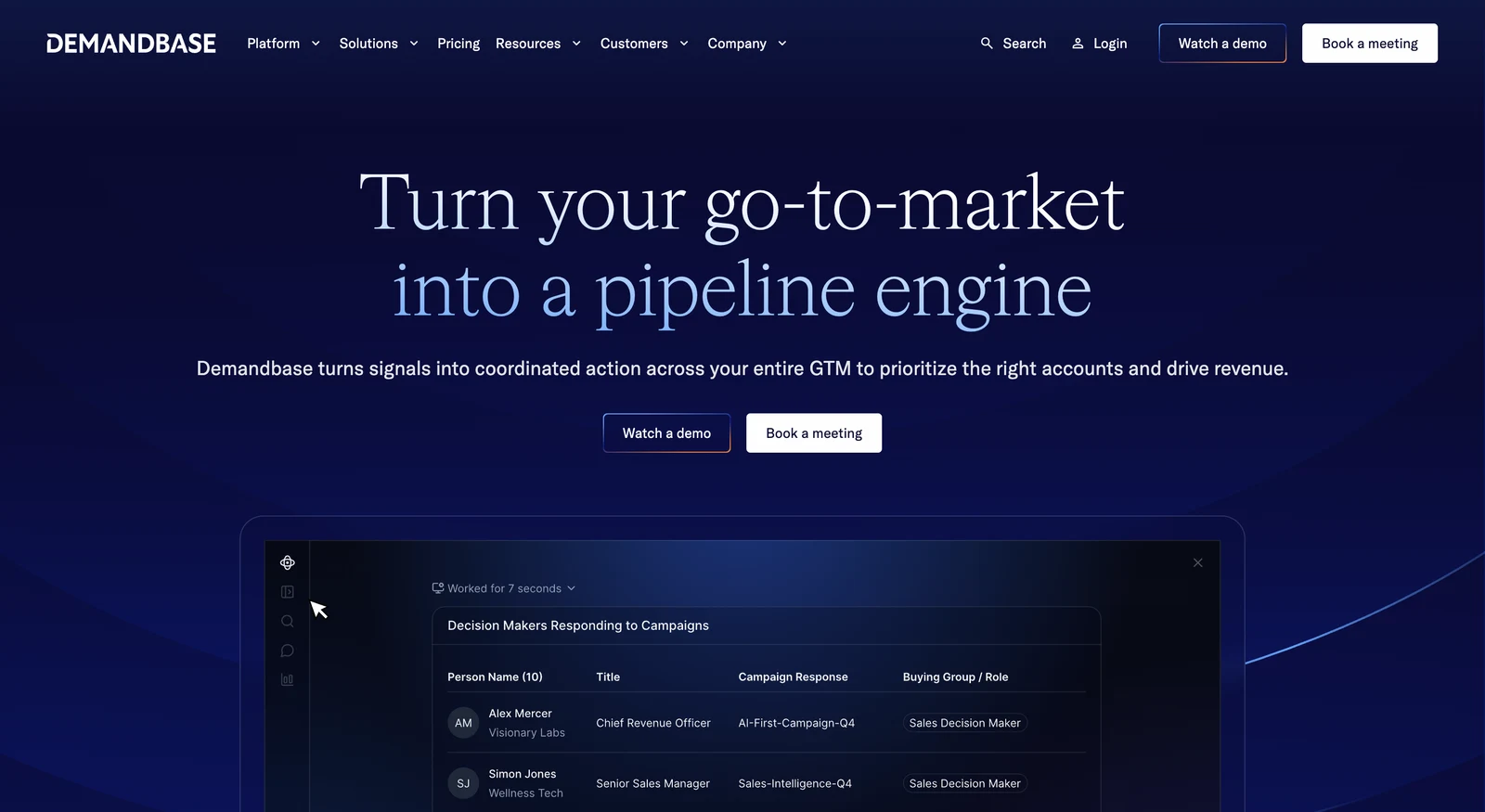
Demandbase integrates with major ad platforms, including Google, LinkedIn, and Facebook. It also describes web personalization based on identifying the visitor's account.
That combination can support a named-account program. Marketing can show content to selected accounts, then sales can watch for engagement and adjust its outreach. A website may also change its message when it recognizes a target company, though teams should confirm how much personalization they can maintain without creating a poor visitor experience.
Demandbase is useful when attribution and campaign reporting matter. Leaders can ask whether target accounts engaged with ads, returned to the site, or moved toward a sales conversation. Those links are stronger than reporting only on clicks or form fills.
The hard part is operational. Account matching can be imperfect. A signal still needs an owner, a response time, and a message that fits the buyer's stage. Without those rules, advertising data becomes another dashboard that sales rarely checks.
Demandbase also doesn't replace contact research or live conversation support. It helps shape account focus. VibeSell helps a rep use account context in the meeting, then turn the conversation into an approved CRM record.
Consider Demandbase when marketing and sales already share an account list and need advertising tied to it.
7. Bombora, cooperative intent data with historical signal baselines
Bombora is an intent data provider that helps teams spot accounts researching topics linked to a potential purchase. Its main value is signal context, especially when a surge is compared with a normal activity level.
Bombora's data cooperative draws from more than 5,000 publisher sites. Its licensing model can fit different parts of a sales stack.
A historical baseline is important. Raw activity can rise because of a news story, a research project, or a large group of students. Comparing current behavior with a normal level gives the sales team more context before it assigns a task.
Bombora can support account prioritization inside a larger workflow. A rep might receive a signal, check the account's fit, review existing CRM history, then choose a relevant message. The signal should guide research, not replace it.
The limitation is the signal-to-action gap. Intent data can tell you that research is happening. It usually doesn't prepare the rep for a live objection or draft a clean follow-up after the call. Teams need another process to carry the insight into the conversation.
Data licensing also needs care. Ask where the signal lands, how often it refreshes, who can act on it, and how it connects to account ownership. A signal without workflow rules tends to lose value quickly.
Bombora fits teams that already know how they will respond to intent. It is less useful as a stand-alone answer to meeting execution.
8. UserGems, fast job-change signals for account expansion
UserGems focuses on job changes and related buying signals. It fits teams that want to find former champions, new decision-makers, and expansion paths inside existing accounts.
UserGems has strong job-change detection speed and accuracy, with integrations for Salesforce and HubSpot. When a contact changes roles, the system can update the CRM with the person's new information.
That creates a useful account expansion motion. A former champion who moves to a new company may be worth contacting. A new hire at an existing customer may also become a missing stakeholder in a deal. These signals help reps find relationships that a static CRM record would miss.
UserGems can also support multithreading, which means building relationships with several people in one account. A sales leader can use job-change alerts to ask whether a deal has the right decision-makers involved, rather than waiting for one contact to carry the whole process.
The caveat is focus. Job changes are a reason to research an account, not proof that it wants to buy. A new role may have no link to your product, and an old champion may not have influence in the new company.
UserGems is strongest when the team has an installed base, a clear ideal customer profile, and a process for acting on alerts. It won't provide a contact database for every market or live prompts during a customer meeting.
Use it when relationship movement is central to expansion and win-back work.
9. Amplemarket, signal detection through personalized sales engagement
Amplemarket combines signal detection, prospect research, and personalized sales engagement. It fits teams that want the intelligence-to-outreach path inside one product.
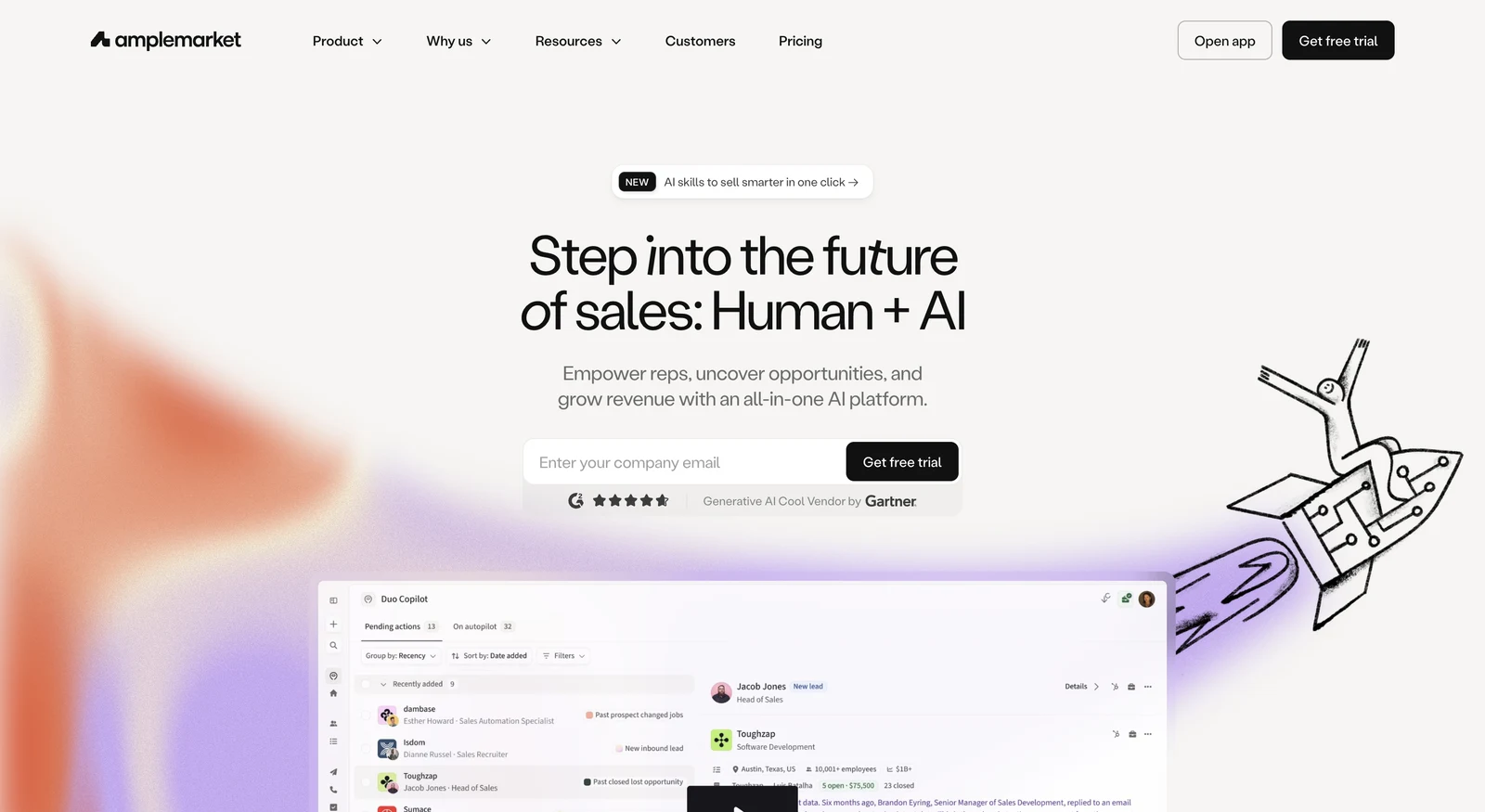
Its Duo AI sales agent can watch for signals such as job changes, website visits, competitor research, funding news, and community activity. It then uses CRM and external context to shape personalized sequences.
Amplemarket handles the entire workflow from signal detection to personalized sequence without leaving the platform. That can reduce the handoffs that slow down a response. A team can also build multichannel steps with email, calls, and social actions, subject to its own approval rules.
Amplemarket's account research and brand knowledge can help a new rep start with more context. The system can learn details about competitors, target personas, case studies, value points, and objection handling from the company's information.
There is an important distinction for sales leaders. Amplemarket is built around prospecting and engagement. VibeSell is built around the meeting itself, including pre-call briefs, sparse live guidance, and approved post-call updates. Those products may sit in different parts of the same stack.
Any AI-generated outreach needs review. A signal can be accurate while the message still sounds wrong. Teams should set approval rules, watch deliverability, and check whether personalization reflects the account rather than merely repeating an event.
Amplemarket suits teams that want to close the gap between a buying signal and outbound action.
10. Clearbit, HubSpot-centered enrichment for marketing and sales data
Clearbit is no longer a stand-alone product. Its capabilities now sit inside HubSpot as Breeze Intelligence, so this option is mainly for teams already committed to HubSpot.
That makes Clearbit useful for a simple question: can we improve the records and visitors already inside our HubSpot system? It is less suited to teams that need a separate, CRM-neutral prospecting database.
The decision angle is stack fit:
| Need | Clearbit, now Breeze Intelligence | What to check |
|---|---|---|
| CRM enrichment | Strong fit inside HubSpot | Confirm which fields refresh and how often |
| New prospect discovery | Limited as a stand-alone option | Check whether you need an external database |
| Website intent | Available through HubSpot features | Review credit use and alert ownership |
| CRM flexibility | HubSpot-centered | Consider Salesforce or a custom stack |
| Live meeting support | Not the core use case | Pair with a meeting companion if needed |
A CRM is built around managing customer and prospect relationships. Enrichment improves those records, but it doesn't automatically improve the conversation that creates the next record.
Teams should also review credits, field ownership, form rules, and data consent before rollout. If HubSpot is the only CRM, the setup may be tidy. If the business runs several systems, the limits become more important.
Choose this route when HubSpot is already the center of our go-to-market stack and enrichment is the main need.
How to choose sales intelligence software for a B2B team
Start with the work that is breaking today. Sales intelligence tools fall into several groups, and they don't solve the same problem.
Contact enrichment
fills missing company and buyer fields.
Intent data
shows research behavior or account activity.
Conversation intelligence
records calls, transcribes them, flags topics, and may score or coach conversations.
Predictive and AI tools
rank accounts or suggest a next action from several signals.
ABM platforms
connect named accounts with campaigns, ads, web activity, and sales plays.
Ask what happens after a signal appears. Does it open a useful task? Does the rep get account context before the meeting? Does the system support the rep during the call? Does it draft approved CRM updates afterward?
That last question is easy to miss. Confirm which workflow steps the tool supports before you buy.
Integration is the next test. Map the full path:
- Where does the data come from?
- Where does the account signal appear?
- Who owns the response?
- What enters the CRM?
- Who approves AI-generated changes?
Pricing needs the same level of care. Compare the full cost, not only the listed seat price. Include data credits, exports, integrations, implementation time, admin work, and the other tools needed to act on the data.
For a 10-person team, a cheap data tool may still be costly if reps spend hours cleaning records. For a 200-person team, a narrow tool may be cheaper but leave managers without the visibility they need. Run a short test with a real segment, define success before the trial, and measure usable outcomes.
Key Takeaway: Pick the tool that closes your biggest workflow gap, then test it inside the CRM and meetings your team already uses.
Sales intelligence software FAQ
What is sales intelligence software?
Sales intelligence software collects account, contact, behavior, and conversation data to help sales teams decide who to contact and what to do next. Some tools focus on contact records. Others focus on intent, account-based marketing, call analysis, or AI meeting support. The right category depends on where your sales process loses time.
What are the main types of sales intelligence tools?
The main types are contact enrichment, intent data, conversation intelligence, predictive scoring, and account-based marketing. Contact tools help find or update people. Intent tools show research activity. Conversation tools analyze calls. Predictive systems rank accounts. ABM tools connect account data with campaigns and website activity.
How does sales intelligence data get into a CRM?
Sales intelligence data usually reaches a CRM through a native integration, browser extension, API, scheduled sync, or workflow connector. Before buying, check field mapping, duplicate handling, sync timing, ownership rules, and approval controls. A connection that moves bad data faster can increase cleanup work instead of reducing it.
Is intent data enough to prioritize a sales account?
Intent data is useful for prioritization, but it isn't enough by itself. Combine the signal with company fit, role relevance, current CRM history, and a reason for contacting the account. A research surge may reflect a real project, but it may also come from students, analysts, or general market research.
What does AI meeting support add to sales intelligence software?
AI meeting support turns account context into help before, during, and after a customer call. A pre-call brief reduces research time. Live guidance can help with an objection or next question. Post-call automation can draft the summary, follow-up, and CRM updates. The rep should review and approve those changes.
How should a sales team compare pricing?
Compare total operating cost, not only the monthly seat fee. Include data credits, contact verification, exports, implementation, admin time, CRM work, and any tools needed for outreach or calls. Then compare the cost with a clear workflow measure, such as hours saved per rep or the time between a meeting and a clean CRM update.
Conclusion
For B2B teams whose main pain is meeting prep, live call support, and CRM admin, VibeSell is the clearest fit in this shortlist. Test it with a real week of meetings, then review the briefs, live prompts, and approved updates with your sales leaders. You can try VibeSell's real-time sales intelligence workflow and see whether it fits your team's day.


